Wakeout study · October 2026

98% of short movement breaks left people feeling better

The Exercise Snack Report 2027 is our first study. Right after a Wakeout routine, the app asks one question: “Do you feel better?” Between April 23, 2026 and October 27, 2026, people answered it 112,031 times. Here is what they said, next to what the public research says about sitting, exercise snacks and how we feel.

By , Co-founder · Published

Default

“Do you feel better?”

  • Yes!73.5%
  • A little24.7%
  • No1.8%
check-ins
112,031
check-ins
people
5,019
people
countries
117
countries
typical routine
2 min 3 s
typical routine

At a glance

Eight things we learned

  1. 01

    98% felt at least a little better

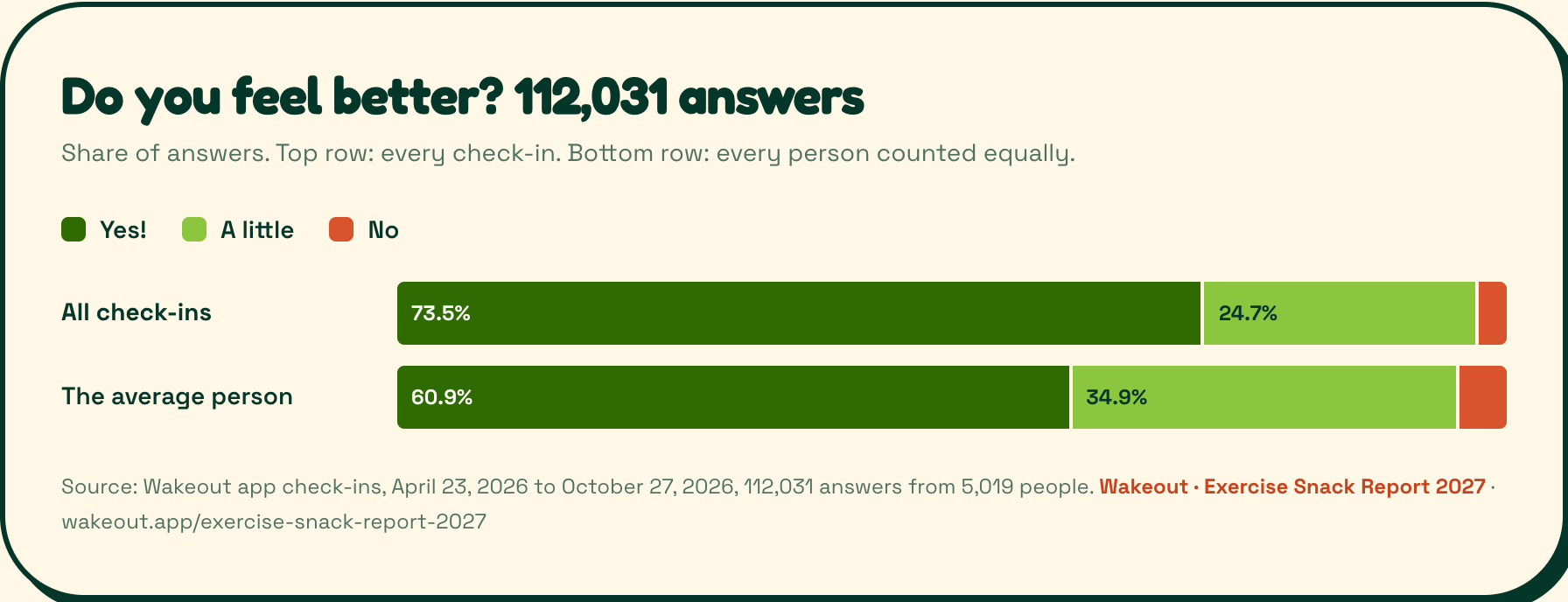
    Of 112,031 check-ins, 73.5% said Yes and 24.7% said A little. Only 1.8% said No. Counting every person equally, so the most loyal users don't tip the scale: 60.9% Yes, 34.9% A little, 4.2% No.

  2. 02

    Two minutes was enough

    The typical routine took 2 min 3 s. 65.9% took three minutes or less, and 85.8% five minutes or less. These are true exercise snacks, not workouts.

  3. 03

    Standing up beat sitting, for every goal

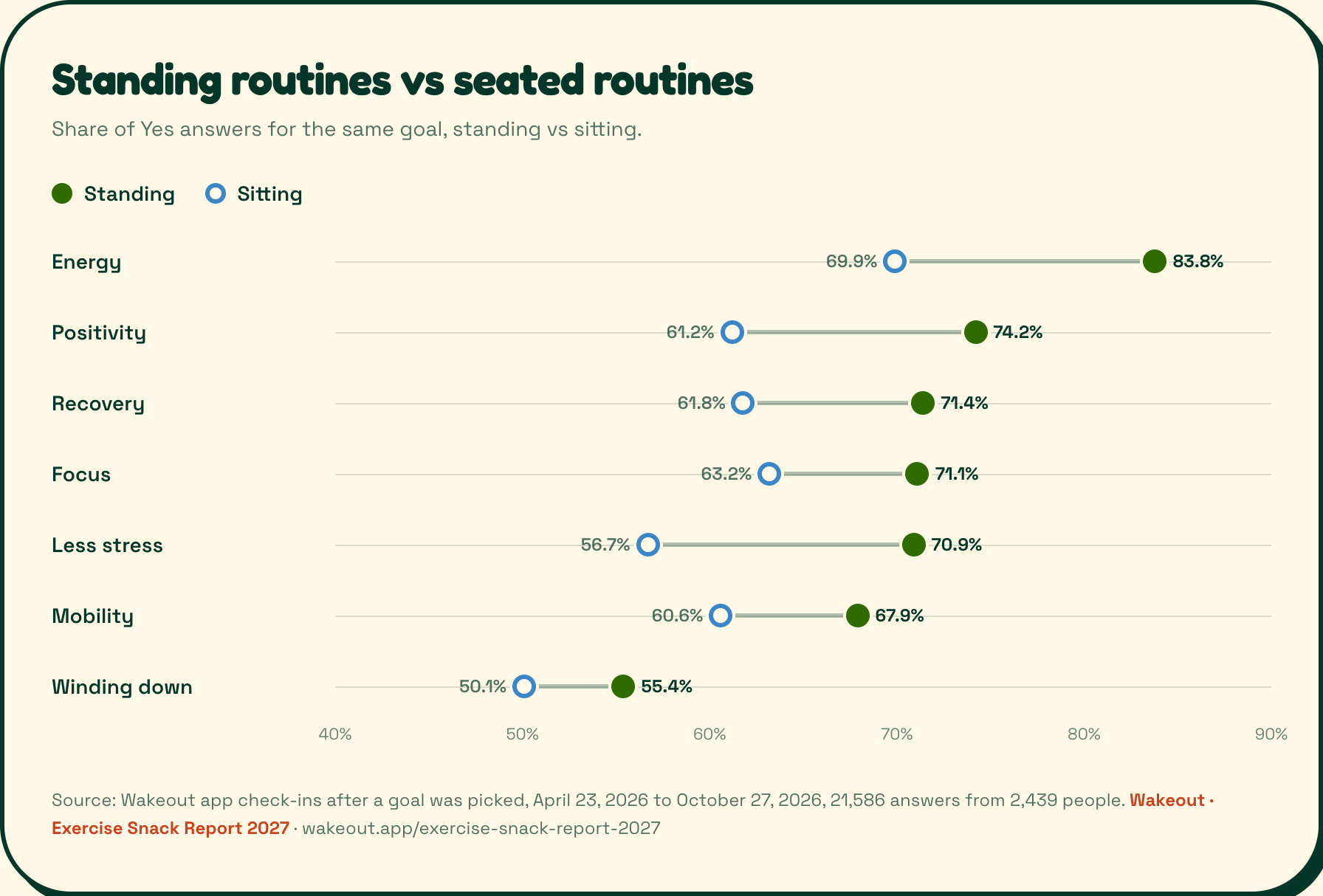
    For all 7 goals we could compare, standing routines got more Yes answers than seated ones: 83.8% vs 69.9% for energy, 70.9% vs 56.7% for stress. Seated breaks still helped: almost nobody said No.

  4. 04

    Energy comes fastest

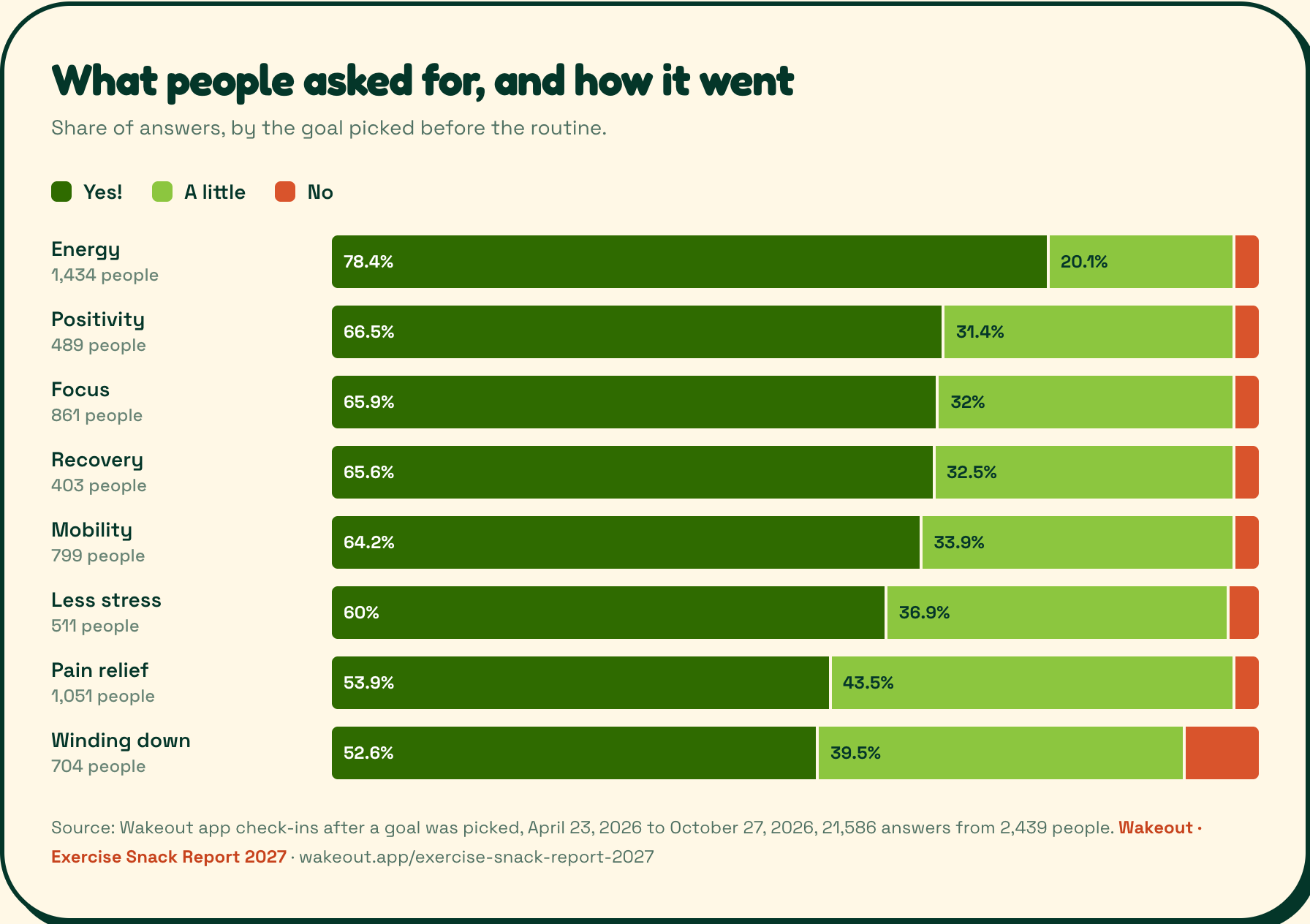
    When people asked for energy, 78.4% said “YES! Energized!”. Pain relief (53.9% Yes) and winding down (52.6% Yes) more often got “A little”: relief builds more slowly than energy.

  5. 05

    It gets better with practice

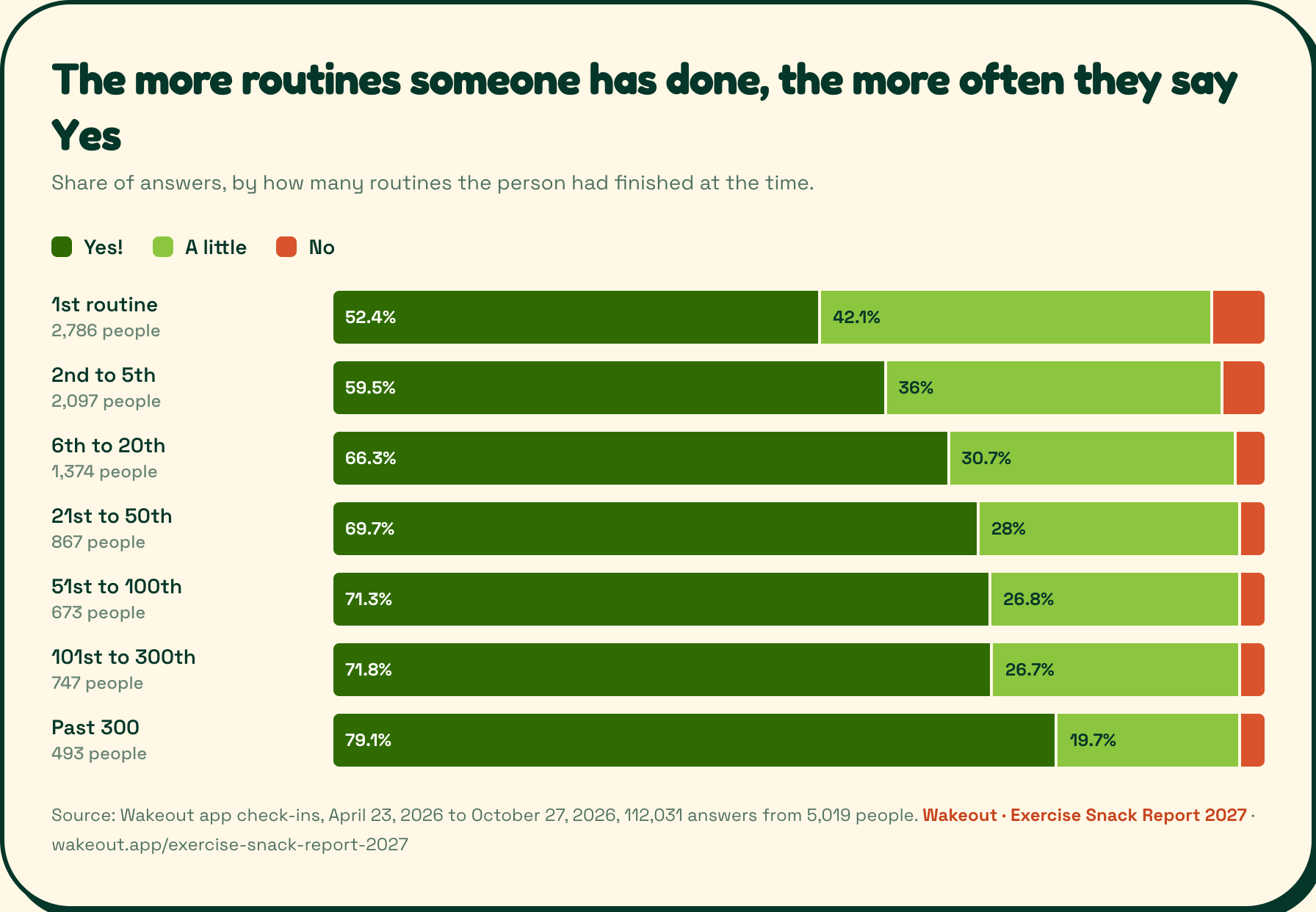
    After someone's very first routine, 52.4% said Yes. Among people past their 300th routine it was 79.1%. Following the same 233 people from their first ten check-ins to their hundredth, Yes rose from 69.8% to 74.7%.

  6. 06

    The desk is where it lands best

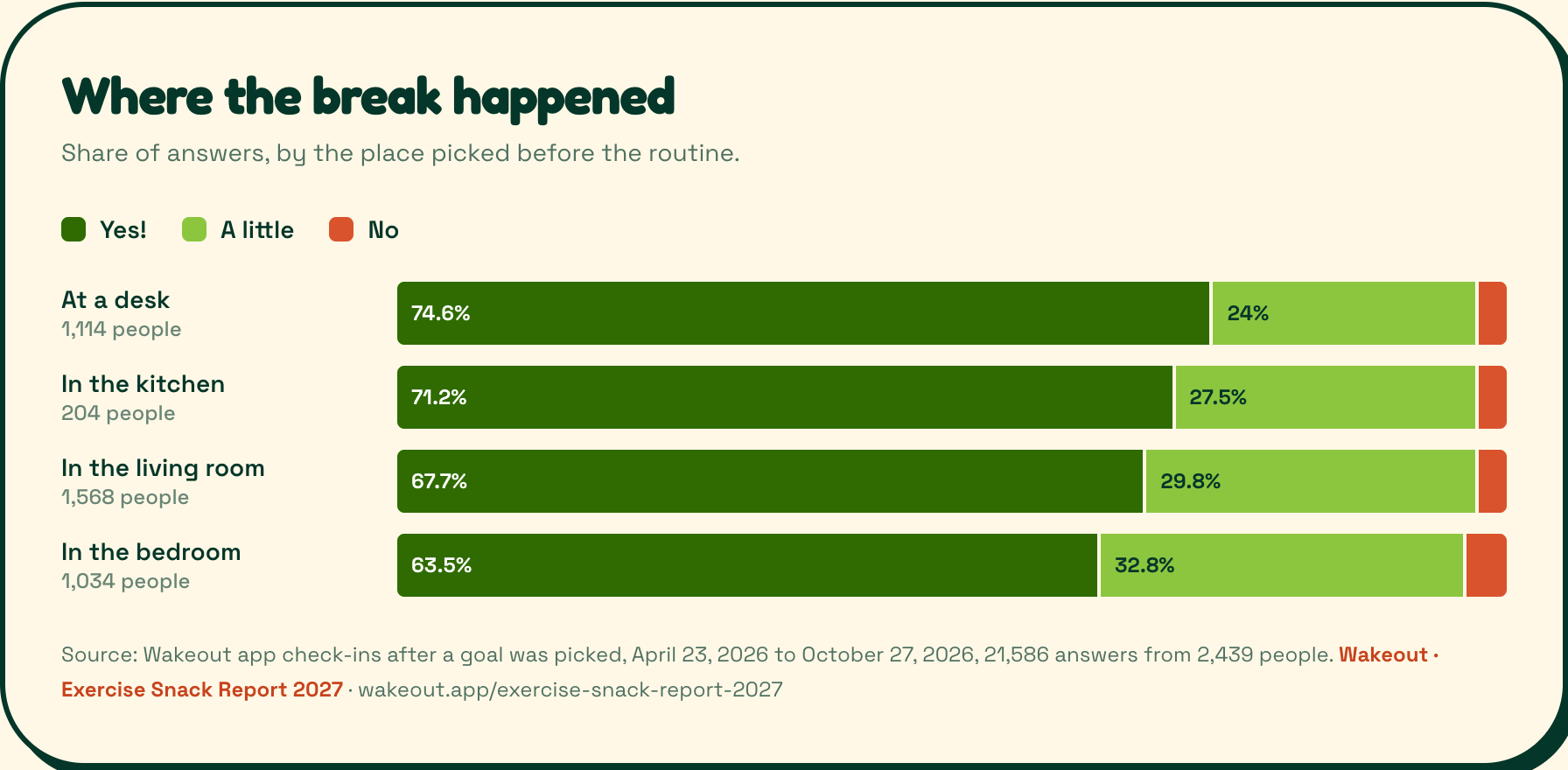
    Routines picked for the desk got 74.6% Yes, the most of any place (living room 67.7%, bedroom 63.5%). The place we sit most is where a break is felt most.

  7. 07

    Mornings are busiest, late evenings lift least

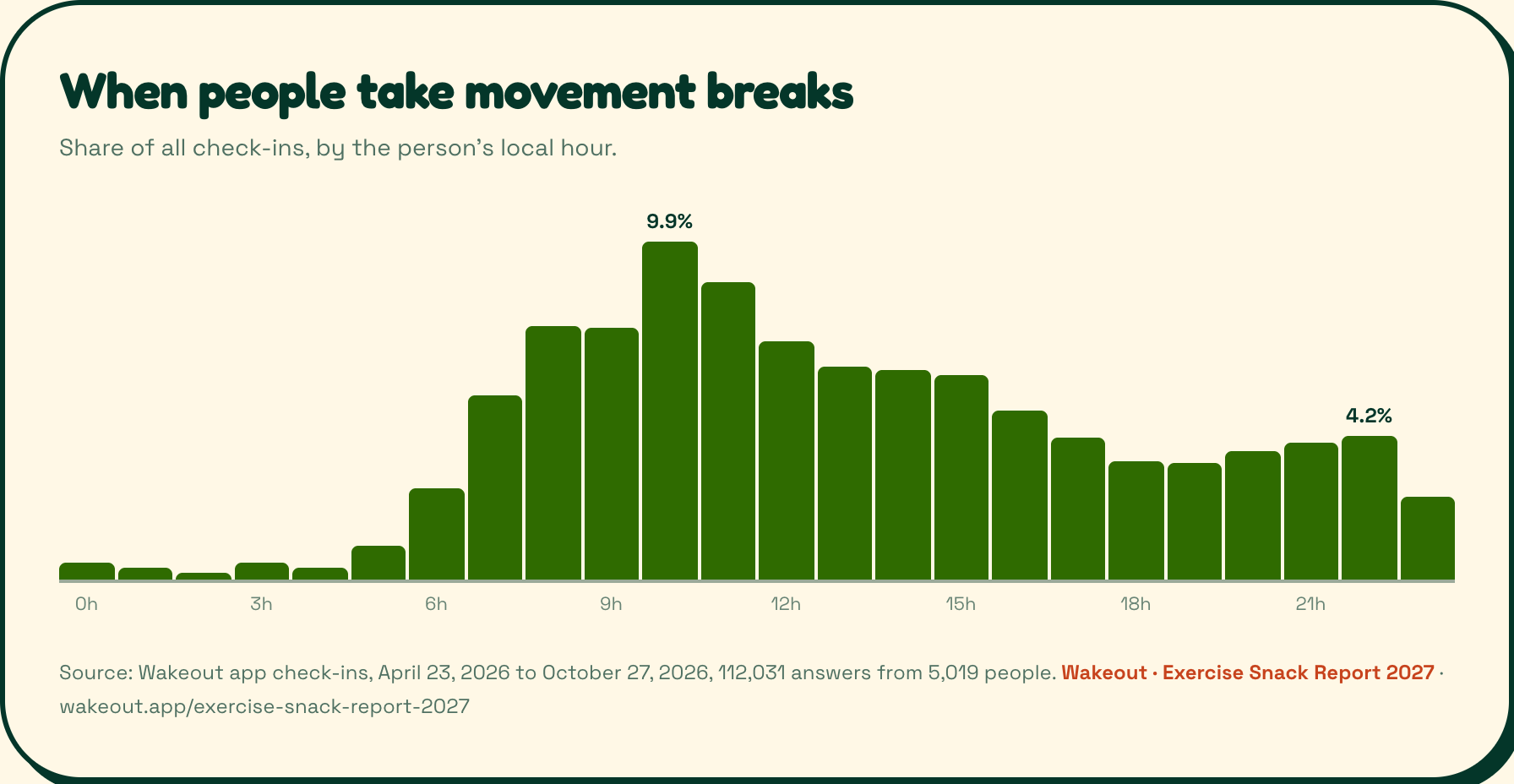
    The busiest hour was 10 AM, with 9.9% of all check-ins. The share of Yes answers held at 72.3% to 76.5% from 7 AM to 8 PM, then dipped to 66.6% at 10 PM, when many people choose calm, sleepy routines.

  8. 08

    The same story in 117 countries

    In each of the 12 countries with at least 40 people, an average person's answers were Yes or A little at least 87% of the time, from the United States to China, Germany, Mexico and Japan.

What we asked

One question, three answers

When a routine ends, the app asks: “Do you feel better?” People tap Yes!, A little or No. If they had picked a goal before starting, the question names it: “Do you feel more energized?” (or focused, relaxed, relieved, and so on), with “YES! Energized!”, A little or No. Answering is optional.

Default

“Do you feel better?”

Yes!A littleNo

After picking a goal (21,586 check-ins)

“Do you feel more energized?”

YES! Energized!A littleNo

98% felt at least a little better

Most people answered a handful of times, and a few loyal members answered hundreds of times. Those loyal members are happier with their breaks, which is why they keep going, so we show both views. Counted either way, at least 95 out of 100 answers were Yes or A little.

Do you feel better? 112,031 answers

Share of answers. Top row: every check-in. Bottom row: every person counted equally.

  • Yes!
  • A little
  • No
  • All check-ins
  • The average person
Source: Wakeout app check-ins, April 23, 2026 to October 27, 2026, 112,031 answers from 5,019 people. Wakeout · Exercise Snack Report 2027 · wakeout.app/exercise-snack-report-2027
Show the numbers
GroupCheck-insPeopleYesA littleNo
All check-ins112,0315,01973.5%24.7%1.8%
The average person5,01960.9%34.9%4.2%

Counted by person: 96.7% of people said Yes or A little in most of their check-ins.

Does it get better with practice?

Partly. People whose breaks didn't help them tend to stop, so long-time members are a happier group by definition. But the effect also shows inside the same people: the 233 people who reached at least 100 check-ins said Yes 69.8% of the time in their first ten, and 74.7% in their 91st to 100th.

The more routines someone has done, the more often they say Yes

Share of answers, by how many routines the person had finished at the time.

  • Yes!
  • A little
  • No
  • 1st routine2,786 people
  • 2nd to 5th2,097 people
  • 6th to 20th1,374 people
  • 21st to 50th867 people
  • 51st to 100th673 people
  • 101st to 300th747 people
  • Past 300493 people
Source: Wakeout app check-ins, April 23, 2026 to October 27, 2026, 112,031 answers from 5,019 people. Wakeout · Exercise Snack Report 2027 · wakeout.app/exercise-snack-report-2027
Show the numbers
GroupCheck-insPeopleYesA littleNo
1st routine2,7932,78652.4%42.1%5.5%
2nd to 5th5,6492,09759.5%36%4.5%
6th to 20th9,2861,37466.3%30.7%3%
21st to 50th10,12586769.7%28%2.3%
51st to 100th10,55167371.3%26.8%1.9%
101st to 300th20,60174771.8%26.7%1.5%
Past 30053,02649379.1%19.7%1.2%

Energy is easy, relief takes longer

When people picked a goal first, the question named it: “Do you feel more energized?”, “…more relaxed?”, “…more relieved?”. Energy, positivity and focus earned the most clear Yes answers. Pain relief and winding down earned the most “A little”. That fits what you'd expect: two minutes can wake you up, but a stiff back or a racing mind usually needs more than one go. Winding down also had the most No answers (8%): feeling sleepy on demand is hard.

What people asked for, and how it went

Share of answers, by the goal picked before the routine.

  • Yes!
  • A little
  • No
  • Energy1,434 people
  • Positivity489 people
  • Focus861 people
  • Recovery403 people
  • Mobility799 people
  • Less stress511 people
  • Pain relief1,051 people
  • Winding down704 people
Source: Wakeout app check-ins after a goal was picked, April 23, 2026 to October 27, 2026, 21,586 answers from 2,439 people. Wakeout · Exercise Snack Report 2027 · wakeout.app/exercise-snack-report-2027
Show the numbers
GroupCheck-insPeopleYesA littleNo
Energy7,3201,43478.4%20.1%1.5%
Positivity1,16448966.5%31.4%2.1%
Focus2,80186165.9%32%2.2%
Recovery85840365.6%32.5%1.9%
Mobility2,83379964.2%33.9%1.9%
Less stress1,03451160%36.9%3.1%
Pain relief3,8711,05153.9%43.5%2.6%
Winding down1,70570452.6%39.5%8%

Stand up if you can

When people picked a goal, they also told us where they were and whether they would sit or stand. For every goal we could compare, standing routines got more Yes answers. The gap was biggest for energy and stress. If you can't stand, seated breaks still work: across all seated routines, 2.6% said No.

Standing routines vs seated routines

Share of Yes answers for the same goal, standing vs sitting.

  • Standing
  • Sitting
  • Energy
  • Positivity
  • Recovery
  • Focus
  • Less stress
  • Mobility
  • Winding down
Source: Wakeout app check-ins after a goal was picked, April 23, 2026 to October 27, 2026, 21,586 answers from 2,439 people. Wakeout · Exercise Snack Report 2027 · wakeout.app/exercise-snack-report-2027
Show the numbers
GroupStanding: YesPeopleSitting: YesPeople
Energy83.8%91969.9%845
Positivity74.2%10061.2%177
Recovery71.4%17561.8%220
Focus71.1%39063.2%658
Less stress70.9%9756.7%202
Mobility67.9%48260.6%403
Winding down55.4%11750.1%402

The day of a movement break

Breaks start around 6 AM, peak at 10 AM and stay high through the working afternoon. The share of Yes answers is steady through the day and dips late at night, when people choose calm routines to fall asleep.

When people take movement breaks

Share of all check-ins, by the person's local hour.

9.9%
4.2%
0h3h6h9h12h15h18h21h
Source: Wakeout app check-ins, April 23, 2026 to October 27, 2026, 112,031 answers from 5,019 people. Wakeout · Exercise Snack Report 2027 · wakeout.app/exercise-snack-report-2027
Show the numbers
Local hourShare of check-insCheck-insPeopleYesA littleNo
0h0.5%55623062.2%35.3%2.5%
1h0.3%35610272.8%23%4.2%
2h0.2%2376468.8%29.1%2.1%
3h0.5%5766975.3%22.7%1.9%
4h0.4%4018080.5%18.2%1.2%
5h1%1,10923575.7%22.8%1.4%
6h2.7%2,99452272.5%25.6%1.9%
7h5.4%6,04191875.2%23.5%1.4%
8h7.4%8,2951,42272.4%26%1.6%
9h7.4%8,2501,46572.9%25.1%2%
10h9.9%11,0751,88372.9%25.2%1.9%
11h8.7%9,7391,80973.7%24.5%1.8%
12h7%7,8431,57275.4%22.7%1.9%
13h6.2%6,9761,52875.9%22.8%1.3%
14h6.1%6,8591,51275.4%22.7%1.9%
15h6%6,7371,51874.7%23.6%1.6%
16h5%5,5571,22973.6%25.2%1.3%
17h4.1%4,6331,12975.1%23.2%1.7%
18h3.5%3,87994076.5%21.7%1.8%
19h3.4%3,79390873.6%24.3%2.1%
20h3.8%4,2011,00072.3%25.8%2%
21h4%4,48296869.8%27.4%2.8%
22h4.2%4,70786666.6%31%2.4%
23h2.4%2,73552770.2%27.6%2.2%

How often people said Yes, by hour

Share of Yes answers, by local hour. Hours with fewer than 500 people are faded.

50%
60%
70%
80%
90%
75.9%
66.6%
0h3h6h9h12h15h18h21h
Source: Wakeout app check-ins, April 23, 2026 to October 27, 2026, 112,031 answers from 5,019 people. Wakeout · Exercise Snack Report 2027 · wakeout.app/exercise-snack-report-2027

The desk wins

Routines picked for the desk got 74.6% Yes, the most of any place (living room 67.7%, bedroom 63.5%). The place we sit most is where a break is felt most.

Where the break happened

Share of answers, by the place picked before the routine.

  • Yes!
  • A little
  • No
  • At a desk1,114 people
  • In the kitchen204 people
  • In the living room1,568 people
  • In the bedroom1,034 people
Source: Wakeout app check-ins after a goal was picked, April 23, 2026 to October 27, 2026, 21,586 answers from 2,439 people. Wakeout · Exercise Snack Report 2027 · wakeout.app/exercise-snack-report-2027
Show the numbers
GroupCheck-insPeopleYesA littleNo
At a desk5,2571,11474.6%24%1.4%
In the kitchen46920471.2%27.5%1.3%
In the living room8,5291,56867.7%29.8%2.5%
In the bedroom4,3961,03463.5%32.8%3.7%

Relief, one area at a time

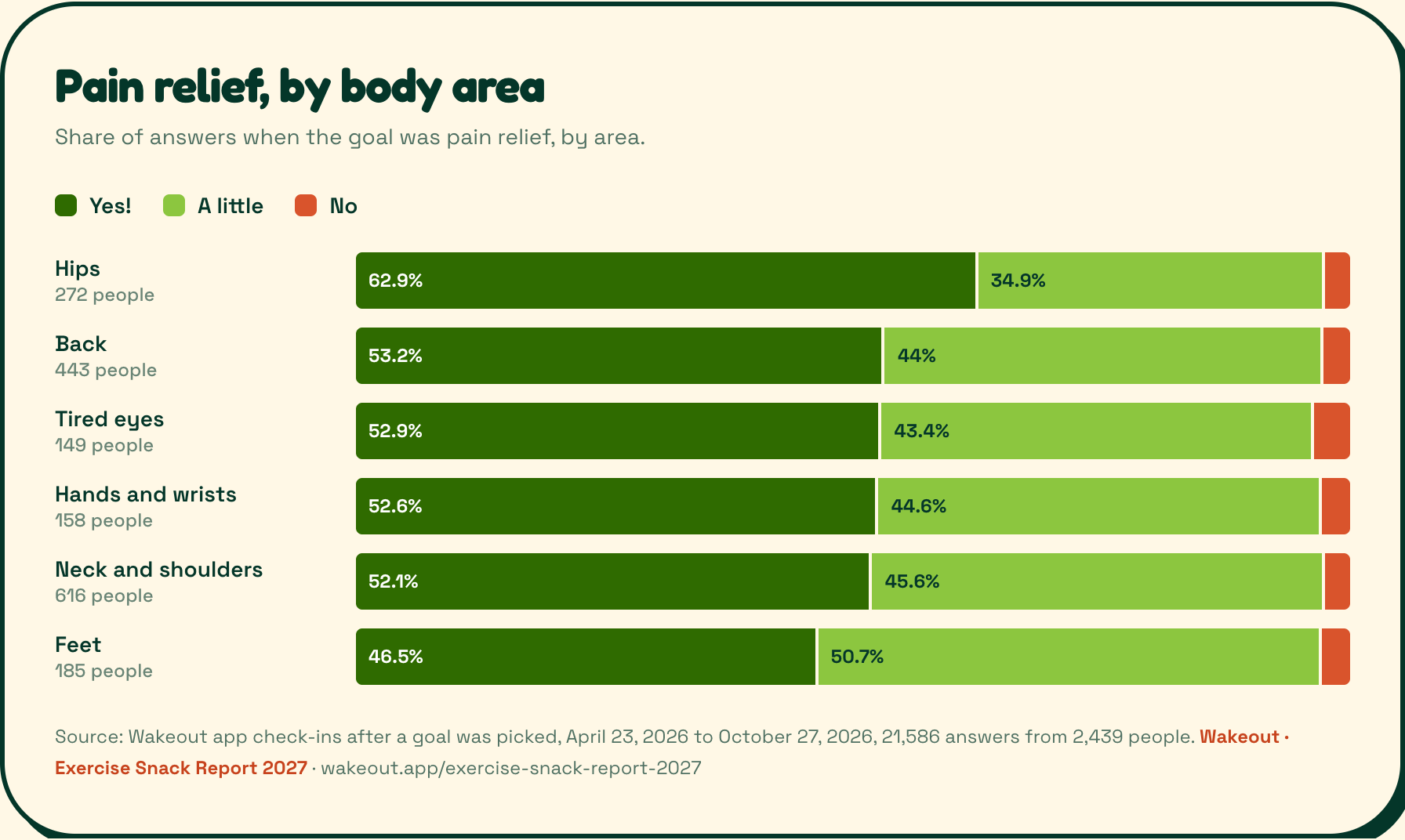
Hip routines got the most clear Yes answers. For necks, backs, hands and feet, “A little” was nearly as common as Yes: a short break eases these, and doing it again matters.

Pain relief, by body area

Share of answers when the goal was pain relief, by area.

  • Yes!
  • A little
  • No
  • Hips272 people
  • Back443 people
  • Tired eyes149 people
  • Hands and wrists158 people
  • Neck and shoulders616 people
  • Feet185 people
Source: Wakeout app check-ins after a goal was picked, April 23, 2026 to October 27, 2026, 21,586 answers from 2,439 people. Wakeout · Exercise Snack Report 2027 · wakeout.app/exercise-snack-report-2027
Show the numbers
GroupCheck-insPeopleYesA littleNo
Hips68527262.9%34.9%2.2%
Back91144353.2%44%2.7%
Tired eyes24414952.9%43.4%3.7%
Hands and wrists25115852.6%44.6%2.8%
Neck and shoulders1,49861652.1%45.6%2.3%
Feet28218546.5%50.7%2.8%

117 countries, one pattern

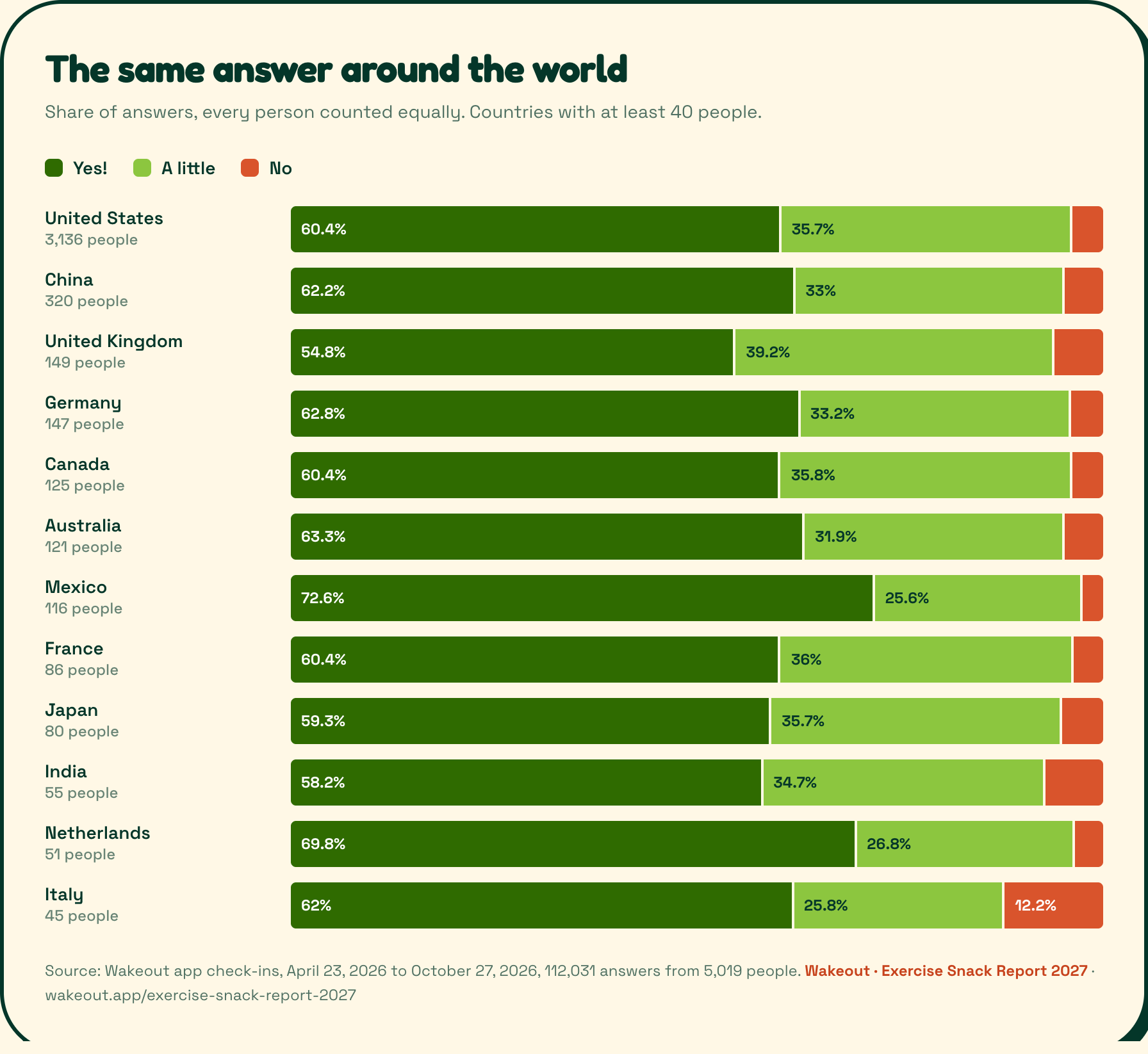
In each of the 12 countries with at least 40 people, an average person's answers were Yes or A little at least 87% of the time, from the United States to China, Germany, Mexico and Japan.

The same answer around the world

Share of answers, every person counted equally. Countries with at least 40 people.

  • Yes!
  • A little
  • No
  • United States3,136 people
  • China320 people
  • United Kingdom149 people
  • Germany147 people
  • Canada125 people
  • Australia121 people
  • Mexico116 people
  • France86 people
  • Japan80 people
  • India55 people
  • Netherlands51 people
  • Italy45 people
Source: Wakeout app check-ins, April 23, 2026 to October 27, 2026, 112,031 answers from 5,019 people. Wakeout · Exercise Snack Report 2027 · wakeout.app/exercise-snack-report-2027
Show the numbers
GroupCheck-insPeopleYesA littleNo
United States71,5333,13660.4%35.7%3.8%
China4,07132062.2%33%4.8%
United Kingdom1,78314954.8%39.2%6%
Germany2,20914762.8%33.2%4%
Canada1,83412560.4%35.8%3.8%
Australia2,84912163.3%31.9%4.7%
Mexico2,29211672.6%25.6%1.8%
France1,6998660.4%36%3.6%
Japan3,2258059.3%35.7%5.1%
India8735558.2%34.7%7.1%
Netherlands1,0705169.8%26.8%3.4%
Italy3,3384562%25.8%12.2%

Day of the week barely mattered: Yes ranged from 72.6% (Friday) to 74.9% (Saturday).

The bigger picture

What the public research says

Our data is one piece. Here is the public evidence it sits next to. Every number below was read in the original paper or WHO release; the numbers in brackets point to the sources at the end.

1.8 billion

Almost a third of adults don't move enough

In 2022, 31% of adults worldwide (about 1.8 billion people) didn't meet WHO's minimum of 150 minutes of moderate activity a week, up from 23% in 2000. WHO expects 35% by 2030 if nothing changes. [1][2]

6.4 hours

We sit more than we used to

US adults' daily sitting rose from 5.5 hours in 2007-08 to 6.4 hours in 2015-16, and one in four sits more than 8 hours a day. [3][4]

Any length

Short bouts count

WHO's 2020 guidelines dropped the old rule that activity had to last at least 10 minutes to count. Bouts of any length now count, and replacing sitting with activity of any intensity, even light, brings health benefits. [5]

1 to 2 min

Tiny bursts, big associations

Among 25,241 UK adults who didn't exercise, about three 1 to 2 minute bursts a day of vigorous everyday activity (stairs, fast walking) were linked with a 38% to 40% lower risk of death from any cause. It's an association, not proof of cause. [6]

30 people

Short breaks lifted mood in the lab

In a trial with 30 adults who sat most of the day, six 5-minute walks spread across the day improved mood and reduced fatigue; one 30-minute walk didn't. Our data is the everyday, large-scale version of that question. [7]

921 people

Exercise-snack trials are still small

A 2026 meta-analysis pooled 21 exercise-snack trials: 921 people in total. A 2026 review of snacks for adults over 60 found 8 studies with 317 people. Our 5,019 people make this one of the largest real-world records of how a short movement break feels. [8][9]
Is sitting the new smoking?

No. The risk of long sitting is real but far smaller than smoking's, and researchers say the two aren't comparable [11]. The good news is that sitting is one of the easiest risks to break up.

How we did it

Method and limits

The data

Every “Do you feel better?” answer given in the Wakeout iOS app (versions 100.14 to 100.17.2, iPhone and iPad) between April 23, 2026 and October 27, 2026: 112,031 answers from 5,019 people in 117 countries. In the same period, people finished 977,312 individual moves and skipped 154,366.

Privacy

We used anonymous app analytics only: no names, no emails, no health data. Person IDs were replaced with one-way codes before analysis, and we publish only totals. Every group shown has at least 40 people. We left out 19 accounts belonging to the Wakeout team and staff testers.

How we counted

Percentages are shares of answers unless a chart says “every person counted equally”: there, we first work out each person's own split of Yes, A little and No, then average those. Hours are the person's local time. Routine length comes from 20,924 routines in three sample weeks (May, July, September): the median was 2 min 3 s.

What this study can't tell you

There is no control group: we don't know how people would have felt without the break. The people are Wakeout members who chose to move, and the ones who answer most are the ones it works for. It's one question, answered right after the routine, in an app that wants you to feel good. We think that is still useful: it's the largest record we know of how a two-minute break feels in daily life. It's not a clinical trial.

For journalists and researchers

Use this report

You're welcome to quote, chart and republish these findings with a link to this page. For interviews, extra cuts of the data or a country breakdown, write to hello@wakeout.co.

Suggested citation

Wunderlich P. The Exercise Snack Report 2027: 112,031 check-ins on how a short movement break makes people feel. Wakeout; October 28, 2026. https://wakeout.app/exercise-snack-report-2027

Sources

  1. [1]Strain T, Flaxman S, Guthold R, et al. National, regional, and global trends in insufficient physical activity among adults from 2000 to 2022: a pooled analysis of 507 population-based surveys with 5.7 million participants. The Lancet Global Health. 2024;12(8):e1232-e1243. doi.org/10.1016/S2214-109X(24)00150-5
  2. [2]World Health Organization. Nearly 1.8 billion adults at risk of disease from not doing enough physical activity. News release, 26 June 2024. www.who.int/news/item/26-06-2024-nearly-1.8-billion-adults-at-risk-of-disease-from-not-doing-enough-physical-activity
  3. [3]Yang L, Cao C, Kantor ED, et al. Trends in Sedentary Behavior Among the US Population, 2001-2016. JAMA. 2019;321(16):1587-1597. doi.org/10.1001/jama.2019.3636
  4. [4]Ussery EN, Fulton JE, Galuska DA, Katzmarzyk PT, Carlson SA. Joint Prevalence of Sitting Time and Leisure-Time Physical Activity Among US Adults, 2015-2016. JAMA. 2018;320(19):2036-2038. doi.org/10.1001/jama.2018.17797
  5. [5]Bull FC, Al-Ansari SS, Biddle S, et al. World Health Organization 2020 guidelines on physical activity and sedentary behaviour. British Journal of Sports Medicine. 2020;54(24):1451-1462. doi.org/10.1136/bjsports-2020-102955
  6. [6]Stamatakis E, Ahmadi MN, Gill JMR, et al. Association of wearable device-measured vigorous intermittent lifestyle physical activity with mortality. Nature Medicine. 2022;28(12):2521-2529. doi.org/10.1038/s41591-022-02100-x
  7. [7]Bergouignan A, Legget KT, De Jong N, et al. Effect of frequent interruptions of prolonged sitting on self-perceived levels of energy, mood, food cravings and cognitive function. International Journal of Behavioral Nutrition and Physical Activity. 2016;13:113. doi.org/10.1186/s12966-016-0437-z
  8. [8]Meng L, Li Y, Chen J, Zheng H. Effects of exercise snacks on cardiorespiratory fitness, body composition, and blood lipids in adults across different age groups: a systematic review and meta-analysis. The Journal of Nutrition, Health & Aging. 2026;100940. doi.org/10.1016/j.jnha.2026.100940
  9. [9]Eidiyan-Kakhki MM, Rajabi H, Amani-Shalamzari S, Motamedi P. The safety, acceptability, and effectiveness of home-based "exercise snacking" for improving physical function of older adults: a systematic review. European Geriatric Medicine. 2026. doi.org/10.1007/s41999-026-01529-4
  10. [10]World Health Organization. Global status report on physical activity 2022. Geneva: WHO; 2022. www.who.int/publications/i/item/9789240059153
  11. [11]Vallance JK, Gardiner PA, Lynch BM, et al. Evaluating the Evidence on Sitting, Smoking, and Health: Is Sitting Really the New Smoking? American Journal of Public Health. 2018;108(11):1478-1482. doi.org/10.2105/AJPH.2018.304649

Questions about the report

What is an exercise snack?

An exercise snack is a very short burst of movement, usually one to a few minutes, done during the day instead of (or as well as) a long workout. Climbing the stairs briskly, a two-minute walk or a quick set of squats all count. In this report, the typical Wakeout routine lasted 2 min 3 s.

Do short movement breaks actually make you feel better?

In our data, people said they felt better after 98% of short breaks: 73.5% Yes and 24.7% A little, across 112,031 check-ins. Lab trials point the same way: in one, short walks spread across the day improved mood and reduced fatigue in adults who sat most of the day. Our study has no control group, so it shows how breaks feel, not what would have happened without them.

Where does the data come from?

From the Wakeout iOS app. After a routine, the app asks “Do you feel better?” with three answers. We analysed every answer from April 23, 2026 to October 27, 2026: 112,031 check-ins from 5,019 people in 117 countries.

Was anyone's personal data used?

No. We used anonymous analytics with one-way codes in place of person IDs, published totals only, and showed no group smaller than 40 people. No names, emails or health records were used.

Can I use these numbers in an article?

Yes, with a link to this page. The CSV has every number behind every chart, and the press contact is hello@wakeout.co.

Will there be another report?

Yes. We plan to publish a study every few months. The next one looks at how long people sit, using a question new members now answer when they join.

Try a two-minute break

Wakeout is the movement app behind this data: short, playful routines from one minute, on iPhone, iPad, Mac and Apple Watch. Seven days free.