Wakeout pack — 11 exercises
Gravity Release
A surrendering routine where you stop resisting gravity and let your head, arms, and body drop and sink. Best for nights when you feel wound up and need permission to completely let go. By releasing your constant fight against gravity, you unlock deep relaxation and prepare for heavy, restful sleep.
sittingbedroomeveningdo anywhere11 exercises
30-second preview
Reach for this when…
You're tired but wired at bedtime and want permission to stop holding yourself up and just let everything drop.
Why this happens
The postural muscles that keep you upright all day don't fully shut off just because you lie down. The erector spinae, deep hip stabilizers, and neck extensors often remain subtly active for hours after you stop needing them, which is one reason people feel physically 'wired' at bedtime even when they're exhausted. Deliberately surrendering to gravity — letting the head drop, the shoulders sag, the spine soften — sends a top-down signal that the job is done and postural tone can release. This is different from stretching. Stretching adds input; gravity release removes it. The mechanism is partly fascial and partly neurological: sustained unloading of postural tissue reduces efferent motor drive, which translates into the felt sense of sinking. This pack is a short series of controlled drops — head-first, shoulders, torso, full-body slumps — designed to disengage the tonic holding patterns that accumulate over a day. It's permission to stop holding yourself up.
About this routine
Best in the final 10–15 minutes before bed, in a quiet space with room to bend forward or sit on the floor. Skip if you have severe herniated disc issues, recent spinal surgery, or conditions where forward folds are contraindicated — surrendering forward with a bad back can make things worse. Safe during pregnancy with modifications (avoid deep forward folds). Not medical advice; this is what the body needs when 'tired but wired' describes the felt sense better than 'sleepy.'
The routine
11 exercises in this pack
#
Back Collapse Surrender
Side Collapse Right
Lean Back Practice
Heavy Back Arch
Dead Arm Shakes Left
5 more in this pack
Unlock the full routine.
The iOS app plays all 11 exercises in order, with audio cues, countdown, and a streak that keeps you honest.
Use this pack when you need to…
Built for these moments
Loosen Neck & Shoulders
Moves aimed at your neck and shoulders, plus arm-only work and push-ups or desk pumps where your arms hold you up.
Why this pack: Moves like Heavy Head Drop, Dead Arm Shakes and Shoulder Weight Drop let your head and arms drop and sink with gravity, so your neck and shoulders can let go.
Frequently asked
What people ask about gravity release
What does 'surrendering to gravity' actually mean?
It means intentionally stopping the small muscular effort it takes to hold yourself up — letting the head hang forward, shoulders round, spine soften, knees bend. Most people don't realize how much constant low-level tension their postural muscles carry until they deliberately release it. The sensation is usually described as 'sinking' or 'getting heavier.' That heaviness is what sleep needs; the body can't transition into rest while the muscles are still on duty.
Why do I feel 'tired but wired' at night?
Usually a nervous-system timing mismatch — you're cognitively exhausted, but the sympathetic (alert) system hasn't downshifted to parasympathetic (rest) yet, often because stress hormones lag behind actual exhaustion. Stimulants, screens, and unfinished tasks all delay the switch. Gravity release works directly on this by reducing postural muscle tone, which sends bottom-up signals to the nervous system that the body is safe to shut down. Mechanical release often beats trying to think your way to sleep.
How is this different from a bedtime stretch routine?
Stretching lengthens tissue under active effort; gravity release removes effort entirely. Both can help before sleep, but they work on different systems. If you're tight, stretching helps. If you're wound up and can't stop bracing, gravity release helps more, because the problem isn't muscle length — it's sustained tonic activation. The giveaway is whether you feel 'stiff' (use comfyTensionRelease) or 'braced' (use this pack).
Can I do this lying down instead of sitting or standing?
Some of it, yes — full-body lying drops and progressive muscle relaxation fit the same category. The pack is designed to be done upright and transitioning downward, because the contrast between holding and releasing is more pronounced. If you're already in bed and don't want to get up, you'll still get benefit from just deliberately going limb-by-limb letting go, but the fuller version uses the seated-to-slumped transition.
You might also like
Packs built for the same body, a slightly different moment.
 14 exercises
Goodnight Self Massage
Gentle self-squeezes that release tension and signal your body it's bedtime.
 14 exercises
Couch Unwind
Pajama-ready cushion movements to transition from screen time to sleep time.
 15 exercises
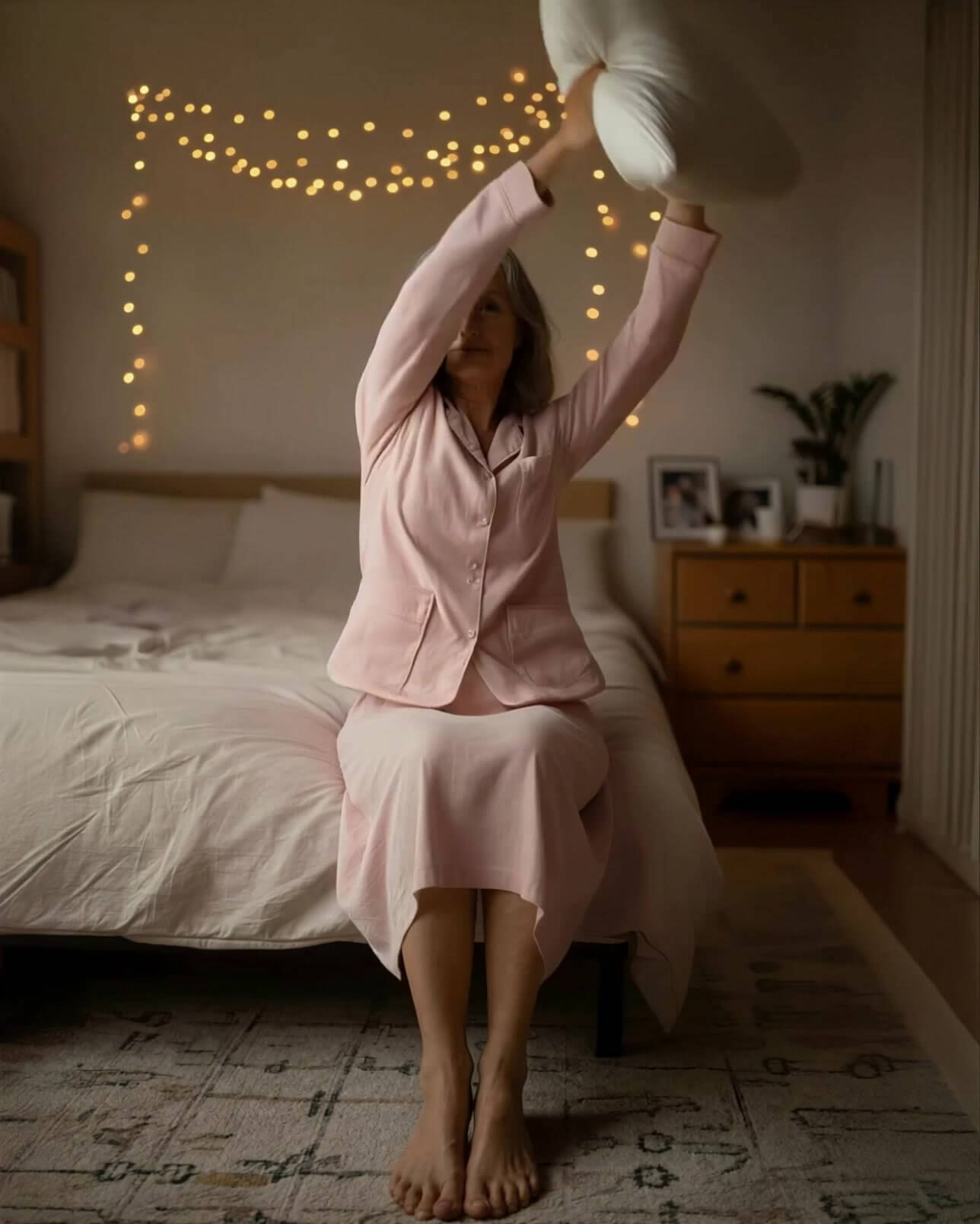
Pillow Breathing And Stretch
Hug and breathe with your pillow to calm your mind for bed.
 11 exercises
Body Scan Wind Down
A gratitude ritual where you thank each body part before rest.
 13 exercises
Couch To Bed Transition
Pressure points and sensory techniques to shift from binge-mode to sleep-ready.
Want the full routine?
Three minutes, guided by audio, in the iOS app. Or add Wakeout to Chrome — every new tab becomes a tiny movement break.